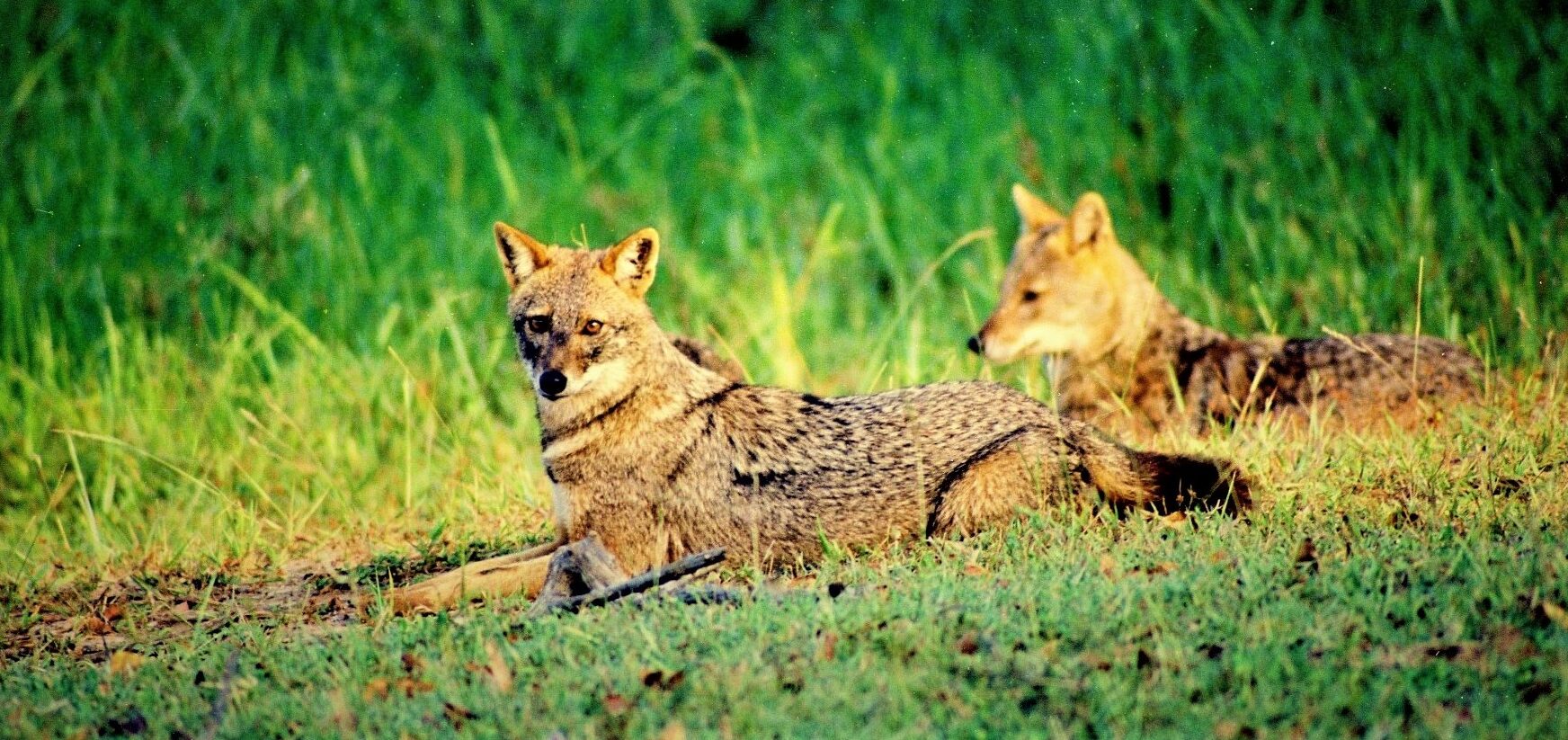
The jackal, leopard and crocodile are the three top predators of Sri Lanka. With recent news about rabies-infected jackal (Nariya or Hivala) attacks in the Kalutara District, public awareness is essential on the killer disease Rabies which affects animals and humans alike. Rabies has no specific treatment, no recovery, but can be prevented. It affects mammals and spreads mainly via the Canidae species which includes dogs and jackals in Sri Lanka. Undomesticated canines, such as coyotes, wolves, jackals, and foxes are the most prone to rabies and serve as reservoirs.
The Sri Lankan jackal (Canis aureus naria), also known as the Southern Indian jackal, is a subspecies of golden jackal (Canis aureus), a wolf-like animal native to Southeast Europe and Asia. It is both a predator and a scavenger and is not a man-eater. The ancestor of golden jackal is believed to be the extinct Arno river dog (Canis arnensis) that lived in Mediterranean Europe during the Early Pleistocene around 1.9 million years ago. All wolf-like canid species share similar morphology and possess 78 chromosomes, allowing them to interbreed, resulting in Jackal–dog hybrids. Jackals are categorized as an endangered wild animal species in IUCN, and protected under Fauna and Flora Protection Ordinance (FFPO) in Sri Lanka.
The disease Rabies (rNi in Sinhala) is estimated to cause 59,000 deaths and annual economic losses of US$8.6 billion, globally. Rabies is transmitted from a bite of an infected animal, and the disease exists both in the urban and wild animal populations. Domesticated animals that move freely between the villages and jungles are ready targets for the virus. Small woodlands had provided ideal environments for habitation by jackal and other wildlife for long periods of time. Twenty three GN divisions in the Kalutara District that are densely human populated were inhabited by jackals. It is assumed that destruction of the forest cover in the area would be one reason for jackals to be in close vicinity to the villages. The areas affected were paddy land surrounded by mono crop plantations with a high canopy cover which provided a good habitat for jackals. They live in Packs and maintain hierarchical social behaviour. Jackals are not visible until late evening and early morning and howling can be heard in the night.
The first record of Rabies in a jackal was on 15th May 2020 in Madurawala divisional Secretariat area. According to news items, around 20 jackals were noted in the scrub forest of Millaniya and rabies in dogs was reported on 6th June 2020 after a pack of dogs were bitten by a rabies infected jackal. A buffalo on 26th June and a cow on 22nd July were found dead after showing severe symptoms and abnormal behavior. A person bitten by a Jackal on 28th July had died on 17th August. On 8th October, a one-year-old child bitten on the leg by a jackal that had entered a house in the Meewanapalana in Horana, received treatment for injuries. Out of the 77.4% of people living in rural areas of the country, 25.2% are children between 1-14 years. When unsupervised, children are more prone to get bitten by an infected animal. Following the death of a young girl, police teams were deployed to guard the area day and night. Villagers were requested not to send their farm animals into the shrub land for grazing, and telephone hotlines 1992 and 1991 were assigned for assistance. Unputrefied carcasses of dead Jackals (18 out of 19) between 14th May and 27th October 2020, tested positive for rabies. The carcasses were recovered from Horana (67%), Ingiriya (17%), Millaniya (16%), Madurawala, and Padukka. Majority of those Jackals had been either killed by villagers or shot by police. However, this outbreak has been successfully controlled by practicing ring vaccination of dogs in the areas affected. Ring vaccination is a strategy to inhibit the spread of the disease by vaccinating animals in an area about 2 Km around each reported infected jackal.
Rabies is caused by a cylindrical shaped single stranded RNA virus of the Lyssavirus genus of the Rhabdoviridae family. The virus enters the body through a wound contaminated with saliva of an infected animal and targets the brain and the spinal cord. An animal infected by rabies, is described as ‘rabid’ derived from the Latin verb rabere “be mad, rave”. Rabies is endemic in Sri Lanka and the dog is the main reservoir of the virus and the key transmitter of the disease to humans, while other animals had also caused disease in Sri Lanka. The Medical Research Institute (MRI) and the Department of Animal Production and Health in Sri Lanka have recorded Rabies in several species between 2005 and 2014: dog (74%), cattle (10%), cat (7%), human (5%), and goat (2.5%). Other mammals were buffalo, mongoose, pig, sheep, squirrel, giant squirrel, palm cat, civet cat, monkey, bandicoot, wild cat and guinea pig.
Once an animal gets infected it loses its sense of direction and starts roaming around aimlessly and salivating profusely. A wild animal that is usually fearful of humans can aimlessly roam in to nearby villages without any fear. Rabid dogs salivate profusely due to paralysis of throat muscles. Rabies in humans is also known as hydrophobia (fear of water), as patients violently refuse to drink water as they cannot swallow due to the paralysis of the throat muscles.
The average estimated dog to human population ratio in Sri Lanka is 1:8. Taking the human population estimate as 21.8 million (census report of 2019-07-01), the dog population of around 2.7 million includes pets, partially-owned dogs and the stray population. Rabies causes 20 to 30 human deaths each year in Sri Lanka due to non-vaccination of dogs against rabies and victims not getting post exposure treatments. It is obviously a colossal task to implement mass mandatory annual vaccination of dogs to achieve 70% coverage in order to eradicate rabies. However, several studies have shown that Rabies can be controlled even under field conditions in Sri Lanka. Rabies is a high financial burden on an endemic country mainly due to expenditure on post-exposure prophylaxis (PEP) given to human patients with animal bites, as reported in the Health Statistical Bulletin of Sri Lanka in 2015.
The easiest and safest, but not the only, method to control the disease Rabies is by vaccination. A healthy dog effectively and properly vaccinated against Rabies with a cell culture vaccine, develops sufficient protection. According to the Expert Committee on the Prevention and Control of Rabies of the College of General Practitioners in Sri Lanka, an “immune animal” is an animal which has received at least two injections of Anti Rabies Vaccine (ARV), provided the last injection was given within one year prior to the bite.
A recommended schedule for the ARV for dogs: When you buy a puppy, check the ARV vaccination record of its mother. If the mother is immunized (vaccinated) prior to her pregnancy, the initial ARV must be given to the pup at 6 weeks of age (after the drop in maternal immunity), followed by a second ARV at 14 weeks of age, and booster vaccines annually. However, if the mother of the pup is not immunized (vaccinates), the pup needs to be vaccinated at the time of purchase or collection, boosters given after 12 and 16 weeks (at 3 and 4 months of age), and revaccinate annually thereafter. Some people, especially children, pick up puppies on the roadside and take them home to adopt. Since the age of the puppy and the immunized details of its mother are not known, the puppy need to be vaccinated immediately after collection, revaccinate after 12 and 16 weeks (after 3 and 4 months), and annual boosters thereafter. Adult stray dogs picked up by the roadside for adoption need a vaccine at the time of collection, boosters after 8 weeks and thereafter annual revaccination. Rabies control programs should also include promoting responsible pet ownership, registration of pets, public awareness on dog vaccination campaigns, notification of suspected Rabies cases of humans and animals, and control of stray dog population by neutering (surgical sterilization).
The author is a former YZA member (1972-) and currently one of the Vice Presidents of Lanka Nature Conservationists (LNC). She may be contacted at indiradush@gmail.com for clarifications or suggestions. The above information was collected from WHO Technical Reports, Government census reports, the World Wide Web, Rabies outbreak in Sri Lanka 2020. – OIE (by Tharaka Prasad), scientific literature, and personal knowledge.
By: Professor Emeritus Indira Nanayakkara Silva PhD, FSLCVS, BVSc
(This Article was printed in YZA Journal Sanrakshana 06-04)