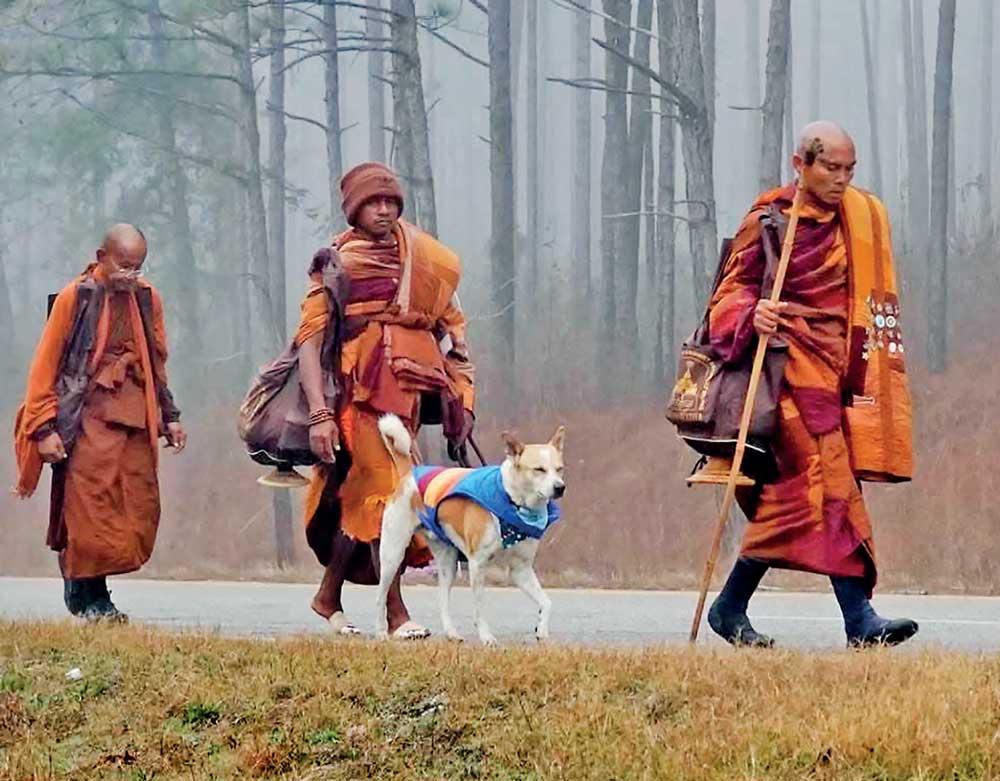
The Peace Walk is led by Venerable Bhikkhu Pannakara and the monks are expected to do a 41 day journey and cover a distance of 2,300 miles to promote peace and kindness
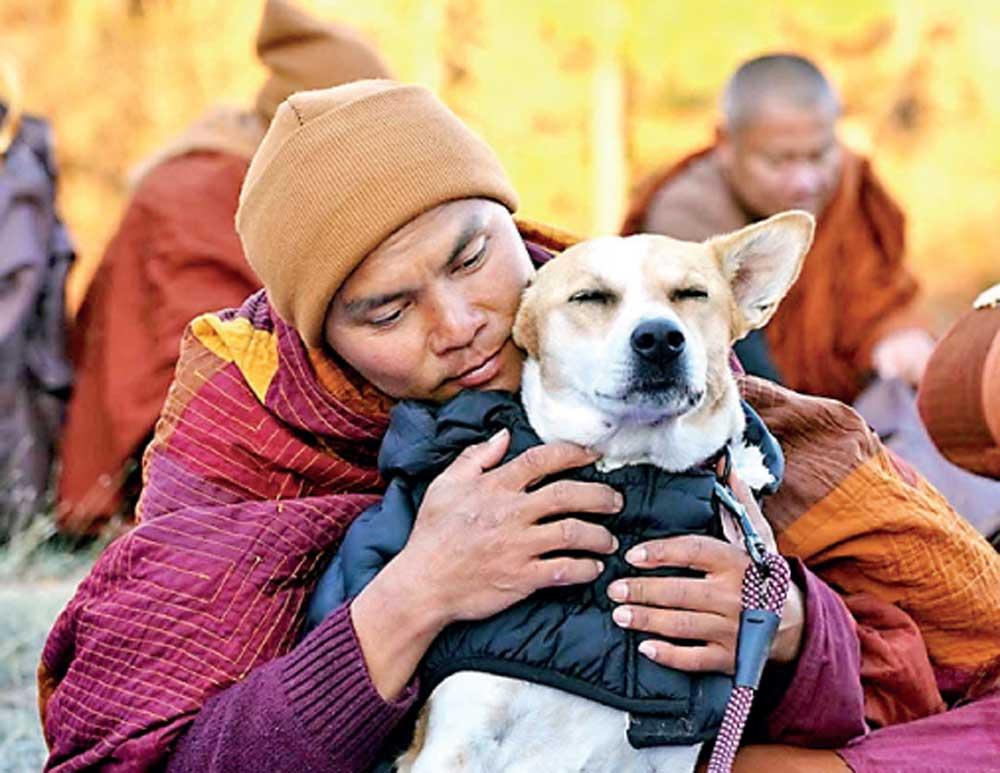
Aloka, the Indian street dog, following the Buddhist monks’ “Walk for Peace” across the United States became a symbol of the walk
- The monks have been widely welcomed in differing religious institutions and communities across the country bringing food to the group and messages of support or help care for the monks and their canine companion
- Aloka is part of a group of Buddhist monks from the Huong Dao Vipassana Bhavana Center in Fort Worth, Texas, USA led by Bhikkhu Pannakara, who embarked on this 2,300-mile “Walk for Peace” from Texas to Washington, D.C. promoting peace, compassion, and unity
By Professor Emeritus Indira Nanayakkara Silva, PhD (USA)
Aloka, the Indian street dog, following Buddhist monks on a 2,300-mile (3,700 km) “Walk for Peace” across the United States became a symbol of the walk. His journey has gained international attention, with over 800,000 followers on social media. Though the canine Aloka is labelled a “pariah dog,” “street dog,” or “mongrel” based on his birth, his enthusiasm and unwavering determination to accompany the Buddhist monks on their peace walk reflect a nobility far beyond such terms. As Gautama Buddha taught: “One is not a superior by birth, nor by birth is one not a superior; by deeds one is a superior, by deeds one is not a superior.”
Aloka is part of a group of Buddhist monks from the Huong Dao Vipassana Bhavana Center in Fort Worth, Texas, USA led by Bhikkhu Pannakara, who embarked on this 2,300-mile “Walk for Peace” from Texas to Washington, D.C. promoting peace, compassion, and unity, one step at a time, amidst the cold, snow storms and winds. On October 26, 2025 they commenced walking meditation, chanting, and spreading messages of compassion and unity to promote peace, to highlight the importance of inner peace and non-violence. The monks follow a strict ascetic code, eating only one meal per day. Each day, growing crowds greet the monks, bringing flowers and gifts and braving harsh weather—an expression of love that carries Buddhism far beyond the temple walls and across the country. People travel for hours to wait along the roadsides, some who have never meditated a day in their lives. Some watch in silence, others weep softly as the monks pass through the towns. When the monks encounter people who are ill or who use wheelchairs, they pause, gather around them, and chant blessings. People sometimes walk with the monks for some distance.
A journey covering 10 States
The monks’ pilgrimage is expected to conclude sometime in February at the U.S. Capitol Washington D.C. to visit the US Congress. Their journey will cover 10 states, including Texas, Louisiana, Mississippi, Alabama, Georgia, South Carolina, North Carolina, Virginia, and Washington, D.C.
Bhikkhu Pannakara, the spiritual leader of the Walk for Peace, explained the purpose of the walk: “We walk not to protest, but to awaken the peace that already lives within each of us. The Walk for Peace is a simple yet meaningful reminder that unity and kindness begin within each of us and can radiate outward to families, communities, and society as a whole. Our walking itself cannot create peace, but when someone encounters us-whether by the roadside, online or through a friend – when our message touches something deep within them, when it awakens the peace that has always lived quietly in their own heart-something sacred begins to unfold. This is our contribution-not to force peace upon the world, but to help nurture it, one awakened heart at a time.” The monks have been widely welcomed in differing religious institutions and communities across the country bringing food to the group and messages of support or help care for the monks and their canine companion. The preceding “Walk of Peace” in 2022 had taken place in India by monks from various monasteries in Bodh Gaya in the Bihar state of India. Some notable monasteries include Maha Bodhi Maha Vihara, Maha Bodhi Society of India, All India Bhikkhu Sangha, Burmese Vihara, Bodhagaya Bana Vihar & Meditation Centre, Wat Thai Buddhagaya, Tergar Monastery, Sujata Stupa, Mahamevnawa Buddhist Monastery (Buddha Gyan Ashram). Bhikkhu Pannakara, the spiritual leader of the Walk, revealed at an interviews, how they met Aloka back in India on day 6 of a 112 day “Walk of Peace” in 2022, walking over 3,000 km with them. While many street dogs followed the monks during the walk, most of them dropped out in a few days, one who had joined the group near an airport in Kolkata, continued to follow the monks and never left. Kolkata is a major city in West Bengal, about 450 km away from Bodh Gaya. The monks adopted this dog and named him “Aloka” meaning “Light” with the intent to help him find the light of wisdom, to liberate suffering to attend Nibbana.
When the time came for the American monks to return to the United States, Bhikkhu Pannakara felt that Aloka deserved a life beyond returning to the streets. Members of the Huong Dao Vipassana Bhavana Center in Fort Worth, Texas, supported this intention and agreed to help bring Aloka to the USA. Through fundraising efforts, temple members raised USD 14,000, while Bhikkhu Pannakara completed the necessary documentation for Aloka’s flight to JFK Airport in New York. After completing a 28-day quarantine, Aloka was transported onward to Texas.
While travelling through the state of South Carolina, the monks noticed Aloka limping due to longstanding knee injuries. They decided he needed medical attention, and on January 12th, veterinary specialists at the Charleston Veterinary Referral Clinic (CVRC) performed orthopedic surgery for a cranial cruciate ligament tear, generously covering the entire cost. The clinic shared that it was an honour, not an obligation, to care for Aloka. His recovery at CVRC was marked by compassion, patience, and kindness, as he rested on a soft bed beside the clinic staff. Aloka was later reunited with the monks, who welcomed him with quiet hugs and gentle kisses. The monks will determine when and how he rejoins the Walk for Peace, saying, “We will take great care of him every step of the way.” Until then, Aloka sometimes travels in the caravan support vehicle (RV) to rest and recover before rejoining the group on foot. During the “Walk for Peace,” the 58 year old Buddhist monk Bhante Dam Phommasan was injured in a road accident, and was not as lucky as Aloka. On November 11th, while the group was walking along the roadside 30 miles East of Houston, Texas, a passing vehicle failed to slow down and slammed on an escort vehicle which then hit monk Phommasam, causing him to fall to the ground and sustained major injuries. Fellow participants and bystanders alerted emergency services to transport him to a hospital for medical treatment. His left leg had to be amputated and spent 30 days in the hospital. The monk said that one good that had happened due to this accident was that the Walk got more attention and publicity.
Authorities later ensured the safety of the remaining participants. Bhikku Phommasam will meet the rest of the team when they reach Washington D.C. in February.
Buddhist monks had practiced Peace walks in the past, though rare in occurrence. In the 1960s, Buddhist monks led by the Venerable Satya Narayan Goenka and others walked from India to the USA as part of a spiritual journey called the “Dharma Caravan” or “Peace Walk”. They traveled on foot, following ancient trade routes, through countries like Nepal, Tibet, and China, and eventually made their way to the USA via Europe.
This article was originally published on “Dailymirror.lk”. You can view the original post here.